
1. Linear Algebra - (2)
Vector Space
Matrix는 Vector를 변환하거나 Vector Space를 정의하는 등 Matrix와 Vector는 매우 밀접한 연관이 있다.
Group
Definition of Group:
-
Consider a set and an operator : × → defined on . Then G := (, ) is called group if the following holds:
- Closure(닫힘성): 어떠한 Operation 에 대하여 인 에 대하여 이다.
- Associativity(결합법칙): 에 대하여 이다.
- Neutral element(중립원) or Identity element: : and
- Inverse element(역원): : and 이면 를 의 inverse 라고 부른다.
- Commutative(Abelian group): : . 벡터공간에서의 덧셈은 아벨군이라고도 부름.
Vector Group의 예시는 다음과 같다.
-
는 Group이다.
- Closure: 두 정수를 더하면 여전히 정수임.
- Associativity: 정수의 덧셈은 결합 법칙을 만족.
- Neutral element: 0.
- Inverse element:
-
는 Group이 아니다.
- Inverse element 가 존재하지 않는다. (e.g. <0, 1>)
-
는 Group이 아니다.
- Inverse element 가 존재하지 않는다. (e.g. <4, 1> → inverse = 1/4)
-
는 Group이 아니다.
- Inverse element 가 존재하지 않는다. (e.g. <0, 1>)
-
는 Abelian Group 이다.
- 실수 행렬에 대해서 덧셈은 조건들을 만족함.
(=정수, =0을 포함한 자연수)
Vector Spaces
Definition of Vector Space:
-
A real-valued vector space 는 다음과 같은 두가지 연산이 정의된 set 이고
- Vector Addition :
- Scalar multiplication :
-
이 두가지 연산이
- is an Abelian group
-
Distributivity:
:
:
- Associativity: :
- Neutral element with respect to the dot operation: :
위의 네 가지를 모두 만족하면 는 Vector Space이다.
추가적으로 Vector Subspace 의 정의는 다음과 같다.
- Let be a vector space and , . Then is called vector subspace of (or linear subspace) if is a vector space with the vector space operations + and restricted to and (closed). We write to denote a subspace of V
예를 들어,
The solution of a homogeneous system of linear equations with unknown is a subspace of 이다.
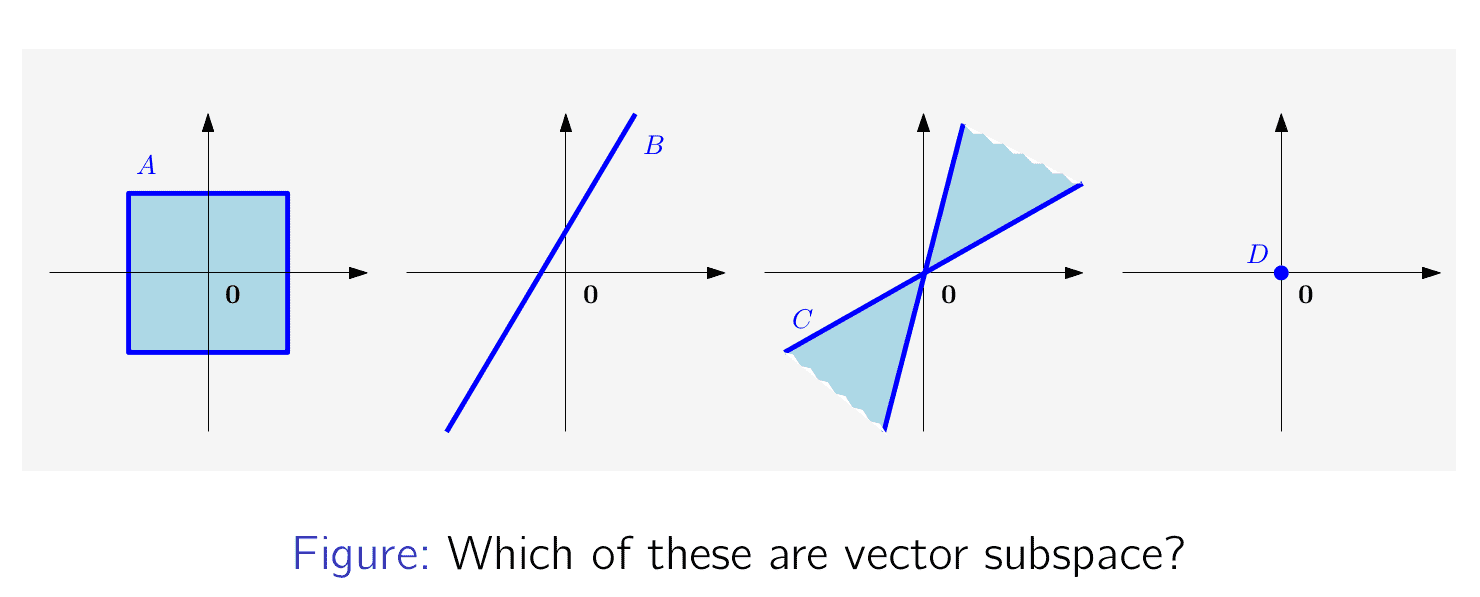
아래의 그림에서는 Vector space 에 대하여 A, B, C, D 중 D만이 Vector subspace이다.
Linear Independence
Linear Combination
Definition of Linear Combination:
- Vector Space 의 vectors 와 scalars 에 대하여 이 둘의 조합 를 Linear Combination 이라고 한다.
Linear (In)dependence
Definition of Linear (In)dependence:
- Let us consider a vector space V with and . If there is a non-trivial linear combination, such that with at least one , the vectors are linearly dependent. If only the trivial solution exists, i.e., , the vectors are linearly independent
- 즉 Linearly independent 하려면, 어떤 vector도 나머지 vector들의 linear combination으로 나타낼 수 없음을 의미함. ( 의 해가 모든 Scalar가 0이 되는것 뿐)
- Row-Echelon Form 의 형태를 만들면, 해당 Vector의 Linear (In)dependence 를 체크할 수 있다.
Basis and Rank
Span
Definition of Generating set and Span:
- Consider a vector space and set of vectors . If every vector can be expressed as a linear combination of , is called a generating set of . The set of all linear combinations of vectors in is called the span of . If spans the vector space , we write or
즉 Vector Space 안에 존재하는 Vector 들로 구성된 임의의 set 에 대하여, Vector space 안의 모든 Vector가 set 안의 vector들의 linear combination 으로 표현이 가능하다면 는 의 generating set이다. 즉, 안의 vector 들이 Vector space 를 생성한다.
안에 포함된 모든 벡터들의 linear combination을 의 span 이라고 하며, 만약 의 span이 Vector Space 와 같다면 라고 표현할 수 있다.
Basis
Definition of Basis:
- Consider a vector space and . generating set of is called minimal if there exists no smaller set that spans . Every linearly independent generating set of is minimal and is called a basis of .
즉 Basis는 Vector Space 에 대한 minimal generating set의 linear independent vector set 라고 할 수 있다.
(e.g. )
Vector들의 Linear independence를 파악하기 위해서, 앞서 배운 Gaussian elimination을 사용할 수 있다.
Gaussian elimination을 거치면 Vector는 RREF 형태로 나오게 되고, 모든 Column에 대해서 Pivot이 존재한다면 linear independent 하다.
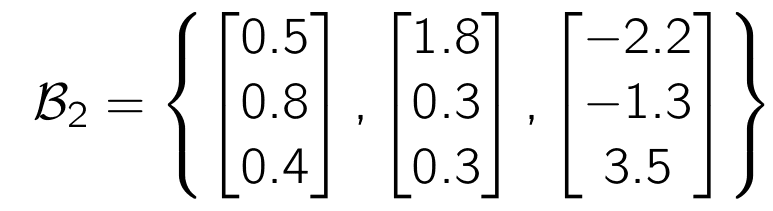
예를 들어, 위의 를 RREF로 만들면 가 되므로 linearly independent하고 각 vector로 공간 상의 모든 Vector를 표현할 수 있는 mininmal generating set이므로, 의 Basis 라고 할 수 있다.
Dimension and Rank
Definition of Dimension:
- There can be many basis of a vector space.
- However, all bases possess the same number of basis vectors.
- The number of basis vectors are called dimension of the vector space.
- The dimension is not necessarily the number of elements in a vector.
즉 Dimension은 해당 Vector Space를 생성하기 위한 최소한의 Vector 수 를 뜻하며, 이는 곧 Basis 의 vector 수를 의미한다.
Definition of Rank:
- The number of linearly independent columns of a matrix
- (=) The number of linearly independent rows of a matrix
- The columns of span a subspace with . This subspace is called image or range
- A matrix A has full rank if
- A square matrix is invertible iff has full rank
Ref:
- POSTECH CSED343 (Prof. Dongwoo Kim)
- Mathematics for Machine Learning, Marc Peter Deisenroth, A. Aldo Faisal, and Cheng Soon Ong, Cambridge University Press 2020